Physical Address
304 North Cardinal St.
Dorchester Center, MA 02124
Physical Address
304 North Cardinal St.
Dorchester Center, MA 02124
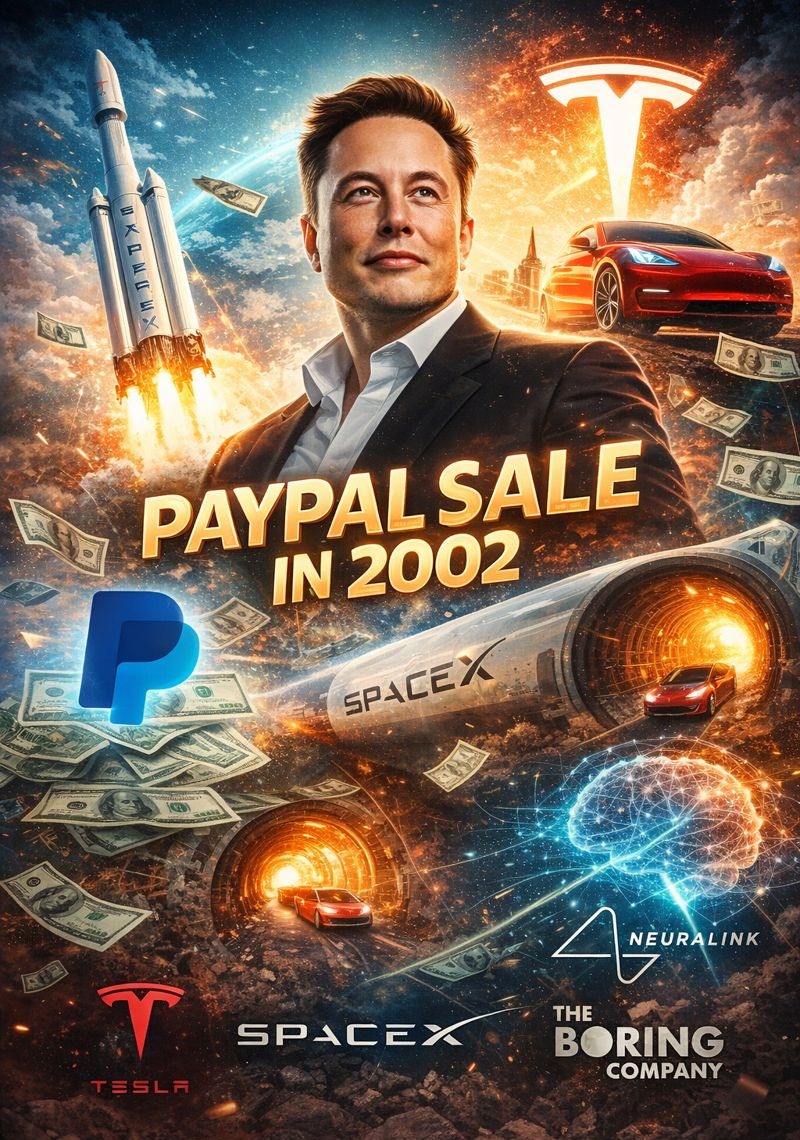
When people talk about Elon Musk today, they often focus on his groundbreaking companies Tesla, SpaceX, Neuralink, and The Boring Company. However, what many overlook is that none of these revolutionary ventures would likely exist in their current form without one defining moment in Musk’s early career: the sale of PayPal to eBay in 2002. That single transaction didn’t just make headlines it fundamentally changed the direction of modern innovation and laid the financial foundation for some of the most ambitious technological projects in human history.
At the time, PayPal was one of the first major digital payment platforms to gain widespread adoption. It solved a real problem sending money securely over the internet at a time when online commerce was still in its infancy. When eBay acquired PayPal for approximately $1.5 billion, it marked a turning point not only for e-commerce but also for Elon Musk personally. As one of PayPal’s largest shareholders, Musk walked away with roughly $165–180 million from the deal. While many entrepreneurs would have used such wealth to live comfortably or retire early, Musk chose a radically different path.
Instead of preserving his fortune, he reinvested nearly all of it into ideas that most investors considered too risky or unrealistic. That decision became the foundation for his future ventures. The capital from PayPal allowed him to take bold risks funding SpaceX when private space travel was considered impossible, investing heavily in Tesla when electric vehicles were seen as niche products, and later launching Neuralink and The Boring Company to tackle problems in neuroscience and urban transportation.
The PayPal exit was more than a financial win; it gave Musk the independence to think long-term. He was no longer constrained by short-term profits or traditional business models. This freedom allowed him to pursue goals aimed at solving global challenges such as sustainable energy, interplanetary survival, and advanced human-machine integration.
In many ways, the sale of PayPal marked the transition of Elon Musk from a tech entrepreneur into a visionary industrialist. It proved that one successful innovation, when paired with bold ambition and reinvestment, can reshape entire industries. The ripple effects of that 2002 deal are still being felt today powering electric vehicles, launching rockets into orbit, and redefining what humanity believes is possible.
That single moment in tech history didn’t just create wealth it ignited a chain reaction that continues to shape the future of technology, science, and human progress.
Before PayPal became a global name, it started as X.com, an online financial services company founded by Elon Musk in 1999. His vision was bold for the time: to create an internet-based financial system that could replace traditional banks.
Around the same period, another startup called Confinity was developing digital payment software, which later evolved into PayPal. In 2000, X.com and Confinity merged, forming what would eventually become PayPal.
Although the merger combined talent and technology, it also created internal conflict. Disagreements over leadership, technology choices, and company direction led to tension among executives.
Despite these challenges, PayPal grew rapidly, becoming the preferred payment method for eBay users.
In 2002, eBay saw PayPal as a critical piece of its marketplace ecosystem. Rather than building a competing system, eBay chose to acquire PayPal outright.
The acquisition was valued at $1.5 billion in stock, one of the most significant tech acquisitions of its time.
At the moment of the sale:
Although Musk was no longer directly involved in PayPal’s leadership, the sale gave him something far more valuable than a job title capital and freedom.
Unlike many entrepreneurs who retire after a major payout, Musk reinvested almost all of his earnings into new ventures that most investors considered too risky.
This decision would reshape industries across the globe.
Musk used a large portion of his PayPal earnings to invest in Tesla Motors, a company aiming to make electric vehicles mainstream.
At the time:
Musk believed otherwise. He funded Tesla during its most difficult years, even risking his entire PayPal fortune to keep the company alive during the 2008 financial crisis.
Today, Tesla is one of the world’s most valuable automakers and a leader in electric vehicle technology, battery innovation, and renewable energy solutions.
Perhaps the boldest use of PayPal money was the creation of Space Exploration Technologies Corp. (SpaceX) in 2002.
At the time, space exploration was dominated by government agencies. Musk believed private companies could reduce launch costs and make space travel sustainable.
SpaceX faced repeated failures, including multiple rocket explosions. At one point, Musk was on the verge of bankruptcy. However, perseverance paid off.
Today, SpaceX:
Without the PayPal sale, SpaceX may never have existed.
Elon Musk later invested in Neuralink, a company focused on developing brain-computer interfaces. The goal is to help treat neurological disorders and eventually enhance human cognition.
This futuristic vision required massive research funding capital that was made possible through Musk’s early financial success.
Neuralink represents a long-term investment in human evolution, showing how PayPal’s sale indirectly funded some of the most ambitious scientific research of the modern era.
Another venture born from Musk’s PayPal wealth is The Boring Company, created to address traffic congestion through underground transportation systems.
The company aims to build efficient tunnel networks for electric vehicles, reducing travel time in major cities.
Although still developing, it demonstrates how Musk used his early wealth to tackle large-scale infrastructure problems rather than pursuing short-term profits.
The PayPal acquisition represents more than a business deal it marked a shift in how technology entrepreneurs could influence the future.
Key outcomes of the sale include:
Many investors focus on profit; Musk focused on impact.
The story of PayPal’s sale offers several important lessons:
The sale of PayPal in 2002 was not the end of Elon Musk’s journey it was the beginning of something far bigger. That one transaction helped finance electric vehicles, private space travel, neural technology, and sustainable energy solutions.
What started as an online payments company became the launchpad for some of the most revolutionary technologies of the 21st century.
In hindsight, the PayPal deal wasn’t just a business success it was the spark that ignited a global transformation in how we travel, communicate, and imagine the future.






[…] in this transformation is Saudi Arabia’s growing relationship with Chinese technology giant Alibaba. As the Kingdom pushes to attract global tech leaders, Alibaba has emerged as a key partner in […]
[…] Internal performance evaluations play a major role. Employees with low or inconsistent performance records are generally not recommended for sponsorship. […]
[…] people across continents. With more than 9 million active users and continuous satellite launches, Starlink has moved beyond experimentation and into the realm of essential global […]