Physical Address
304 North Cardinal St.
Dorchester Center, MA 02124
Physical Address
304 North Cardinal St.
Dorchester Center, MA 02124
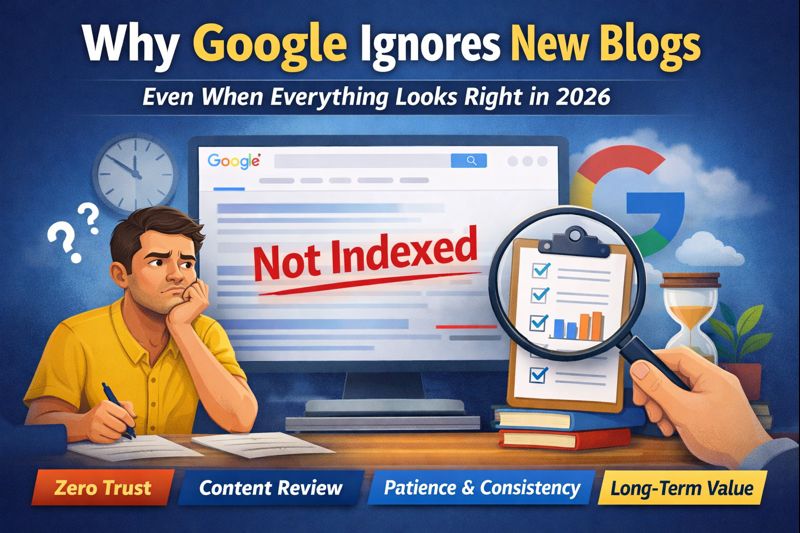
If you are trying to understand why Google ignores new blogs even when everything looks right in 2026, you are facing one of the most frustrating realities of modern SEO. Your website loads fast, HTTPS works, Search Console shows no major errors, the sitemap is valid, and your content looks polished. Yet Google barely responds. No rankings. No impressions. No traffic.
This situation feels confusing because you did what most SEO guides recommend. The problem is simple but uncomfortable: Google’s definition of “everything looks right” is very different from yours.
In 2026, Google does not reward setup, tools, or surface-level optimization. It rewards trust, patterns, and long-term usefulness. This article explains what is really happening, why new blogs struggle even when they appear perfect, and how Google actually decides when to take a new website seriously.
Most new bloggers evaluate their sites using checklists:
From a human point of view, the site looks complete.
From Google’s point of view, none of this proves value.
Google does not rank websites because they are correctly configured. Google ranks websites because they demonstrate reliability over time. Technical correctness only allows Google to access your site. It does not convince Google to trust it.
In 2026, Google operates in an environment filled with risk:
Because of this, Google assumes that every new blog could be temporary.
Even if your content is good, Google still asks critical questions:
Until Google answers these questions with confidence, it limits your visibility. This is not punishment. It is protection.
One strong article does not build trust anymore.
In 2026, Google looks for behavioral consistency, including:
A new blog can publish an excellent article and still remain invisible because Google does not trust single actions. Google trusts repeated behavior.
If your blog looks like a short experiment, Google treats it like one.
Many new bloggers panic when they see this message in Search Console:
“Crawled – currently not indexed.”
This status does not mean rejection.
It means:
Google delays indexing when it wants more evidence that a page deserves permanent visibility. For new blogs, this delay is common and expected.
Think of it as a review phase, not a failure.
Most people believe content quality comes first. In practice, consistency comes first.
Google watches:
A blog with average content and consistent publishing often earns trust faster than a blog with excellent content and random activity.
Consistency signals seriousness. Randomness signals risk.
Many new blogs try to cover too many topics at once:
Humans can follow this variety. Google cannot easily classify it.
Google needs to answer one question clearly:
“What does this website help people with?”
If your blog does not answer that question consistently, Google cannot place you in a clear category. Without a category, ranking becomes difficult.
Focused blogs build trust faster than broad ones.
Google does not penalize content for being written with AI.
Google penalizes content that:
If your article could appear on any website without change, Google sees no reason to promote it.
Original content does not require creativity. It requires clarity, intent, and usefulness.
SEO plugins help with structure and optimization, but they do not measure value.
A page can score high and still fail because:
Google does not rank pages because they look optimized. Google ranks pages because users feel helped.
Clear explanations outperform perfect keyword placement.
In 2026, Google relies heavily on behavioral signals.
It tracks:
If users land on your page and leave quickly, Google learns that the page did not meet expectations. Over time, this feedback influences indexing and ranking decisions.
This is why structure, readability, and clarity matter more than length.
Older websites benefit from years of stored signals.
New blogs have none.
Google needs time to collect data about:
In 2026, Google prefers slow validation over fast promotion. This approach filters out short-term projects and protects users from low-value content.
Many bloggers respond to low visibility by publishing more content. This often backfires.
Rapid publishing can signal:
Google prefers:
Quality combined with patience beats volume.
Google understands your website through relationships between pages.
If each article stands alone, Google sees no structure.
Internal links tell Google:
Without internal linking, even good content feels isolated and unimportant.

In 2026, Google rewards progress.
It looks for:
A blog that improves existing content builds trust faster than a blog that only publishes new posts.
Here is the uncomfortable truth:
A new blog can do everything right and still need time.
Because Google is not just evaluating your website. It is evaluating:
That judgment cannot be rushed.
Google rewards new blogs that show:
These signals tell Google:
“This website is serious and worth keeping.”
Instead of chasing technical fixes, focus on fundamentals.
Stay focused for several months. Let Google understand your purpose.
Two or three posts per week on set days builds reliability.
Explain one idea clearly. Avoid unnecessary jargon.
Use internal links to build topic clusters.
Update weak sections. Add clarity and examples.
Write to solve problems, not to impress algorithms.
Most blogs quit too early.
They assume:
In reality, this phase filters out impatience.
Google rewards persistence.
When Google ignores new blogs even when everything looks right in 2026, it does not mean your website has a problem. Google is not rejecting your content or punishing your site. Instead, Google is carefully evaluating whether your blog is worth trusting in the long term.
Google wants to protect users from low-quality and short-lived websites. Many new blogs publish a few posts and then disappear. Because of this, Google takes time to observe new sites. It watches how consistently you publish, whether your topics stay focused, and how users interact with your content.
Most blogs fail during this stage because their owners lose patience. When traffic does not arrive quickly, they stop publishing or change direction. Google notices this behavior and assumes the site is temporary.
The blogs that continue publishing helpful content, stay focused on one topic, and improve over time slowly earn trust. Google begins to see them as reliable sources rather than experiments.
Google rewards patience, clarity, and consistency because these signals show commitment. If you keep improving your content, stay consistent, and do not quit early, Google will eventually recognize your effort and give your blog visibility.