Physical Address
304 North Cardinal St.
Dorchester Center, MA 02124
Physical Address
304 North Cardinal St.
Dorchester Center, MA 02124
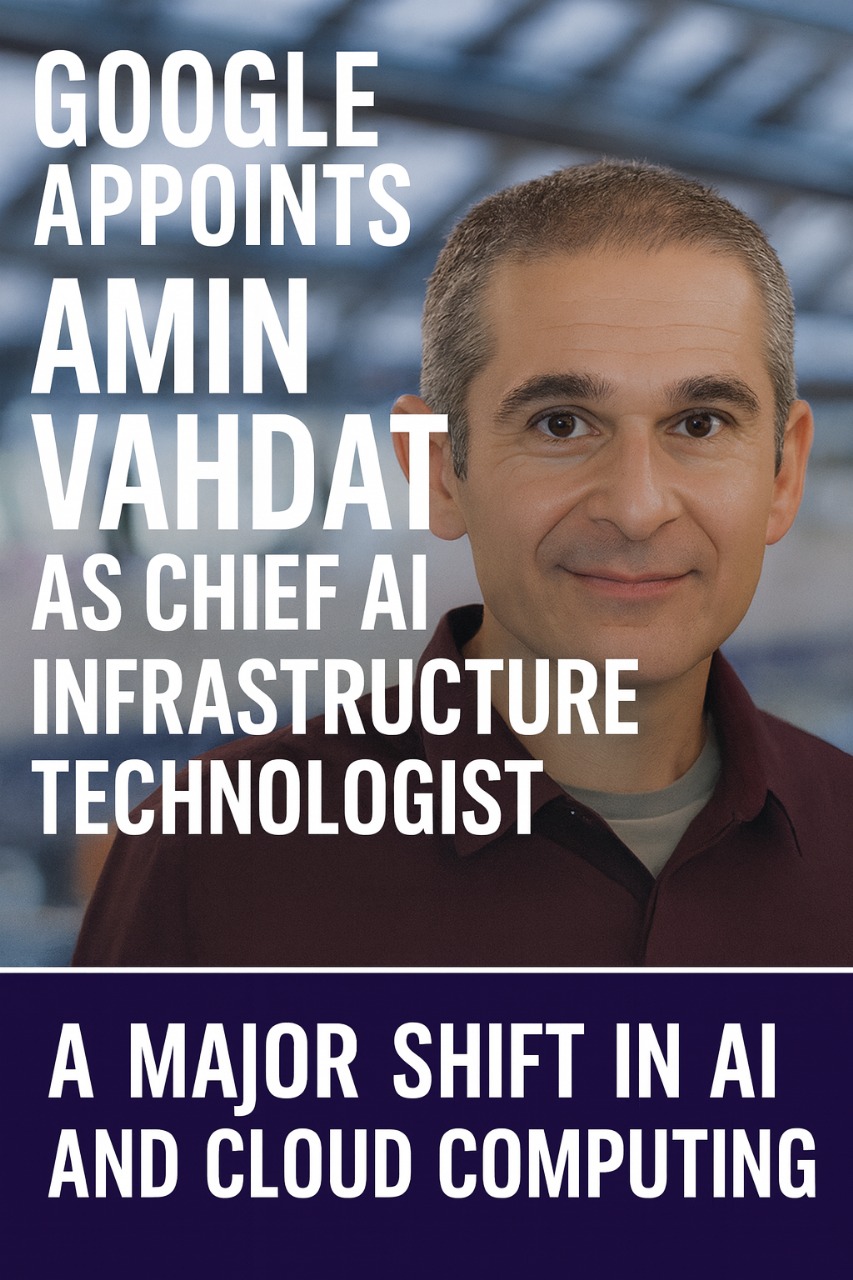
Google has made a decisive move in the global artificial intelligence race by selecting Amin Vahdat as its Chief AI Infrastructure Technologist. This appointment marks a significant milestone in Google’s evolving strategy to strengthen its AI systems, expand its cloud leadership, and build next-generation infrastructure capable of supporting trillion-parameter models and real-time AI workloads.
At a time when AI has become the center of global competition, the leadership of a technologist who has spent years designing some of the world’s most advanced distributed systems gives Google a sharper edge. This role is not symbolic; it is strategic, timely, and crucial for the future of Google’s AI dominance.
Amin Vahdat is not just another engineer in Silicon Valley. He is one of the leading minds in distributed systems, large-scale networking, and hyperscale computing infrastructure.
His career includes:
Vahdat’s work has directly influenced:
In short, Amin Vahdat is a technologist who operates at the intersection of:
This makes him an ideal leader for Google’s increasingly complex AI ecosystem.
The timing of Vahdat’s appointment is not accidental. The AI industry is entering a new era of:
Google faces competition from:
To stay ahead, Google must combine:
This is exactly where Amin Vahdat specializes.
Google is entering a phase where AI systems must scale faster than ever, and Vahdat’s leadership ensures that scaling will happen with precision, innovation, and efficiency.

This is not a traditional executive position. It is highly technical and highly strategic.
As Chief AI Infrastructure Technologist, Vahdat will oversee:
Google’s TPUs are critical to training models like Gemini and PaLM.
Vahdat will drive:
This is essential for reducing the cost per training run, which is one of the biggest challenges in AI.
Modern AI workloads require:
Vahdat’s experience with the Jupiter network positions him to build data centers tailored specifically for AI.
As models expand and diversify, Google needs infrastructure that can:
Vahdat will help ensure the infrastructure keeps pace with the innovation.
Google Cloud is aggressively targeting enterprise AI adoption.
Vahdat’s leadership will improve:
This ensures Google Cloud can compete with Microsoft Azure in AI-powered enterprise solutions.
His appointment signals a major shift in how Google is thinking about AI infrastructure.
Below are the key transformations expected under his leadership:
Training a model like Google Gemini requires:
Vahdat’s innovations will help reduce:
This will accelerate Google’s ability to release new and improved models faster.
Today, Nvidia GPUs dominate the AI industry.
Google wants TPUs to:
Under Vahdat, TPUs will likely become:
This helps Google compete in a market where Nvidia currently holds the upper hand.
To train large AI models, chips must communicate fast.
Vahdat’s work on Google’s Jupiter fabric is legendary because it delivers:
This type of network design is essential for connecting tens of thousands of TPUs in a single cluster.
AI systems consume enormous amounts of electricity.
Under Vahdat, Google will push improvements in:
This reduces operational cost and helps Google meet sustainability goals.
Businesses today want:
Vahdat’s systems will directly improve:
This strengthens Google’s commercial AI offerings.
Google’s biggest challenge in AI is not innovation it is scaling.
It already has:
But now, scale determines winners.
Who can train faster?
Who can deploy larger models?
Who can offer cheaper compute to enterprises?
Vahdat’s appointment shows Google is serious about:
This move strengthens Google’s full-stack AI strategy from chips, to data centers, to cloud services, to consumer AI products.
Amin Vahdat’s leadership represents a broader shift happening across the AI world:
Google is preparing for an era where:
Vahdat will play a key role in designing the systems that make all this possible.
By selecting Amin Vahdat as Chief AI Infrastructure Technologist, Google is sending a clear message to the industry:
It is ready to scale AI faster, bigger, and more efficiently than ever.
His appointment strengthens:
In the rapidly evolving tech landscape, the companies that master AI infrastructure will lead the future.
With Vahdat’s leadership, Google moves one step closer to securing that leadership.
Amin Vahdat is a leading technologist specializing in distributed systems, networks, and hyperscale computing. Google appointed him as Chief AI Infrastructure Technologist to lead the next generation of AI systems.
Google selected him to strengthen AI infrastructure, enhance TPU capabilities, and optimize data centers for large-scale AI models and enterprise workloads.
He will oversee TPU development, AI-optimized data centers, hyperscale networking, and advanced computing systems for training massive AI models.
Vahdat’s leadership will improve Google Cloud’s AI performance, reduce latency, enhance reliability, and strengthen enterprise AI capabilities.
TPUs will become more powerful, cost-efficient, and scalable, helping Google compete with Nvidia’s AI hardware dominance.
It positions Google to train larger AI models faster, optimize compute cost, enhance infrastructure efficiency, and compete with Microsoft, OpenAI, and Amazon.
He will improve energy efficiency, network bandwidth, cooling systems, and chip-to-chip interconnects for AI-focused data centers.
Yes. Faster, more efficient AI infrastructure will accelerate the development and deployment of future Gemini and large-scale foundation models.
Businesses using Google Cloud will experience improved AI performance, faster training capabilities, lower costs, and more reliable model hosting.
He will define the future of Google’s AI infrastructure, shaping TPU innovation, data center design, and the scaling of global AI systems.
Yes, Vahdat’s expertise in large-scale distributed systems will accelerate TPU innovation, improve chip interconnect speeds, and enhance power efficiency.
It is likely, as AI-optimized data centers are essential for supporting large GPU/TPU clusters and high-bandwidth machine learning workloads.






[…] Digital transformation acceleratedBusinesses rapidly adopted cloud tools, remote communication platforms, AI, and […]
[…] that quickly went viral across social media platforms. What was initially promoted as a showcase of advanced artificial intelligence robots turned into a worldwide talking point after observers discovered that the so-called humanoid AI […]
[…] Google Appoints Amin Vahdat as Chief AI Infrastructure Technologist: A Major Shift in AI and Cloud C… […]
[…] Google Appoints Amin Vahdat as Chief AI Infrastructure Technologist: A Major Shift in AI and Cloud C… […]
[…] Google Appoints Amin Vahdat as Chief AI Infrastructure Technologist: A Major Shift in AI and Cloud C… […]
[…] does not rank websites because they are correctly configured. Google ranks websites because they demonstrate reliability over time. Technical correctness only allows Google to access your site. It does not […]