Physical Address
304 North Cardinal St.
Dorchester Center, MA 02124
Physical Address
304 North Cardinal St.
Dorchester Center, MA 02124
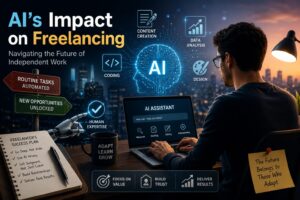
Freelancing has always been a bet on yourself. You trade the safety net of a salary for the freedom to choose your projects, your clients, and your hours. That bet is now being reshaped by a force nobody fully controls: artificial intelligence. It’s changing what clients expect, what skills are worth paying for, and what it even means to be “good at your job” as an independent professional.
This isn’t a story with one simple ending. AI is closing some doors for freelancers and opening others, often in the same breath. Understanding which is which is the real work ahead.
Let’s start with the uncomfortable part. A lot of freelance work has historically been valuable not because it required deep expertise, but because it required time and consistency that a client didn’t want to spend themselves. Writing a first draft of a blog post. Cleaning up a spreadsheet. Producing a simple logo or a template-based video. Transcribing an interview.
AI tools now do a passable version of all of this almost instantly. That doesn’t mean AI does it well in every case it often produces something generic, occasionally wrong, and missing the judgment a skilled human would bring. But “passable and instant” is a brutal competitor for “good but slow and billed by the hour.” Clients who used to hire a freelancer for a routine task increasingly try the AI-generated version first, and only bring in a human when the result clearly isn’t good enough.
The freelancers most exposed here are generalists people who built a business on being reliably competent across a wide range of ordinary tasks rather than being exceptional at one specific thing. That business model is under real pressure, and no amount of optimism changes that.
Here’s the flip side. Every time a technology takes over the routine parts of a job, it tends to create new work built around managing, directing, and correcting that technology. AI is no exception. Someone has to decide what the AI should actually be asked to do. Someone has to catch its mistakes, since AI models still confidently produce wrong or shallow answers with some regularity. Someone has to combine AI output with real domain knowledge legal nuance, brand voice, technical accuracy, cultural context that the AI itself doesn’t reliably have.
This is where freelancers who lean into AI rather than compete against it are finding an advantage. A freelance writer who uses AI to speed up research and first drafts, but brings real editorial judgment and a distinctive voice to the final piece, can now take on more clients without lowering quality. A developer who uses AI to scaffold code but understands system architecture, security, and the client’s actual business problem is more valuable than ever, not less because the bottleneck has shifted from “who can write the code” to “who can be trusted to make it work correctly, safely, and to the client’s real intent.”
In other words, AI hasn’t eliminated the need for expertise. It’s eliminated the reward for expertise’s absence. The freelancers who were coasting on “adequate” are struggling. The freelancers who were already excellent are finding that AI makes them faster without making them replaceable.
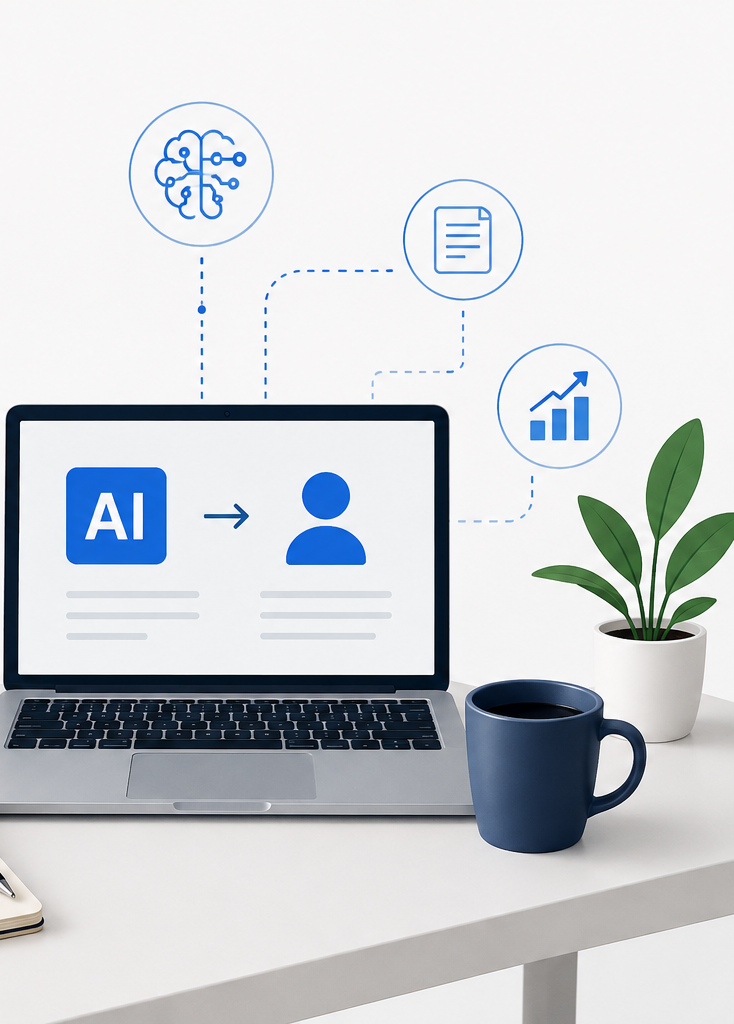
It’s worth remembering that this shift isn’t only happening to freelancers. It’s happening to how clients think about hiring in general. When a client can get a rough draft, a first pass, or a basic prototype for free from an AI tool, their whole mental model of “what am I actually paying a human for” changes. Increasingly, they’re not paying for output anymore they’re paying for judgment, accountability, and results they can trust without checking every line themselves.
This is pushing freelance work away from being billed by the hour and toward being judged by outcomes. Clients care less about how long something took and more about whether it actually solved their problem. That’s a real shift in leverage: a freelancer who can show up with a track record of solving the right problem, not just executing tasks quickly, is going to command better rates and steadier relationships than one who competes purely on speed or price.
Stop competing where AI already wins. If your value proposition is “I can do this routine task reasonably well and reasonably fast,” that ground is shifting under you. It’s worth an honest, sometimes uncomfortable assessment of which parts of your work fall into that category and a plan to move away from them before the market forces the issue.
Go deep instead of wide. The freelancers weathering this best tend to be the ones who picked a lane a specific industry, a specific type of problem, a specific level of technical depth and became genuinely excellent at it. Depth is much harder for AI to fake convincingly than breadth.
Use AI as an assistant, not a rival. The freelancers thriving right now aren’t the ones ignoring AI out of principle, and they aren’t the ones outsourcing their judgment to it either. They’re the ones treating it like a very fast, occasionally unreliable junior assistant useful for speed, but never trusted blindly with the final call.
Sell judgment, not just labor. If a client can get a rough version of your output from a free tool, your pitch can’t be “I’ll produce this thing.” It has to be “I’ll make sure this thing is actually right, actually fits your situation, and won’t embarrass you later.” That’s a fundamentally different and more durable kind of value.
Build relationships, not just gigs. One-off transactional work is exactly the kind of engagement AI is best positioned to erode. Ongoing relationships, where a client trusts you with judgment calls over time, are much harder to automate away, because trust itself doesn’t transfer to a chatbot.
None of this means freelancing is dying if anything, the appetite for flexible, on-demand expertise is only growing, because businesses want access to specialized skill without the overhead of a full-time hire. What’s dying is the version of freelancing that depended on being an adequate substitute for effort a client didn’t want to spend themselves. AI has made that substitute far cheaper and faster to get elsewhere.
What’s rising in its place is a version of freelancing built on things AI still can’t reliably offer: real judgment, accountability, taste, and the ability to understand what a client actually needs even when they can’t fully articulate it. That’s always been the hardest part of the work to fake for AI or for a mediocre human. Freelancers who lean into that will find this isn’t the end of independent work. It’s the point where independent work starts to matter more, not less.
Q1. Will AI replace freelancers?
Answer: AI is unlikely to replace freelancers entirely, but it is changing the kind of work clients are willing to pay for. Routine and repetitive tasks are becoming easier to automate, while work that requires creativity, critical thinking, problem-solving, and industry expertise remains in demand. Freelancers who adapt and learn to work alongside AI will have a significant advantage.
Q2. Which freelance jobs are safest from AI?
Answer: Freelance roles that rely on human judgment, creativity, and specialized expertise are the most resilient. These include software development, UX/UI design, consulting, legal and financial writing, technical writing, video production, digital marketing strategy, project management, and brand development. AI can assist with these jobs, but it cannot fully replace the experience and decision-making of skilled professionals.
Q3. How can freelancers use AI effectively?
Answer: Freelancers can use AI to speed up research, generate ideas, draft content, write code, organize data, and automate repetitive tasks. However, AI should be treated as a productivity tool rather than a replacement for professional judgment. Reviewing, editing, fact-checking, and customizing AI-generated work are essential to maintaining quality and client trust.
Q4. Is freelancing still a good career in 2026?
Answer: Yes. Freelancing continues to offer excellent opportunities in 2026, especially for professionals with specialized skills and a strong personal brand. As businesses increasingly seek flexible talent, freelancers who combine AI tools with real expertise, effective communication, and consistent results are well positioned to succeed in the evolving job market.